


Apr 30,2026 / CABINETS
Best Kitchen Cabinet Materials in India: Plywood vs MDF vs Particleboard — Which to Buy?
So you're planning a new kitchen, or maybe a full modular renovation, and somewhere between picking a colour and arguing about the chimney height, someone asks you a simple question — what material are the cabinets made of?
Just like that, you are staring at three options: Plywood, MDF, and Particleboard. Three names, three price tags, three different lifespans. Pick the one, and you will be replacing shutters in four years. Pick the one and your kitchen will outlast your loan payments.
Let us break this down properly. Without the showroom sales pitch and with India's weather, water, and termites in mind.
The Quick Answer (For People in a Hurry)
If you only read one line, for Indian homes, BWP plywood for Kitchen Cabinet Materials is the best choice. It handles moisture, holds screws for years, and survives our humidity better than anything in the price range.
And this matters. The right choice depends on your budget, your kitchen layout and how long you actually plan to live there. So stick around. The next five minutes will save you ₹40,000–₹80,000 in regrets.
Why the Material Decision Matters More in India
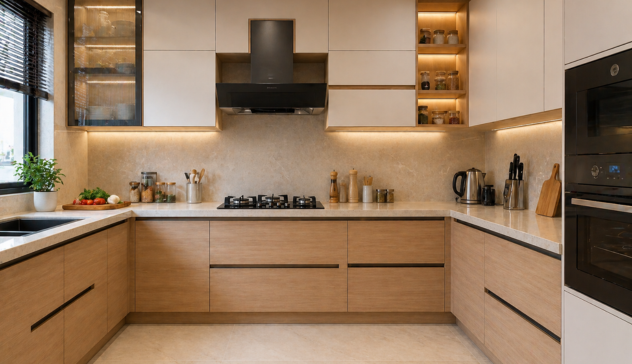
Kitchens take a beating. Think about it. We pressure-cook every day. Steam from the kadhai hits the underside of the wall units. The dishwashing area stays wet for hours. In Mumbai or Kochi monsoon humidity sits at 85% for months.
That is why your modular kitchen material has to do more than just look pretty in the showroom photos. It has to survive life. The leaky pipe under the sink you will discover three years from now the spilled dal nobody wiped up, the small flood from the RO unit.
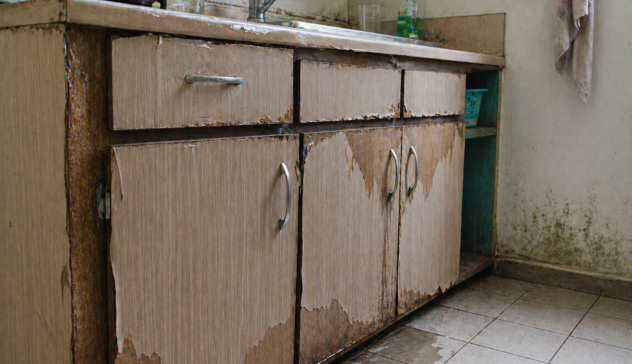
Cheap material fails first at the joints. The screws loosen. Shutters start sagging. The bottom edges swell up like a soaked biscuit. Once that starts there is no fixing it. Only replacing it.
So let us look at what each option does.
Option 1: Plywood — The Long-Term Workhorse
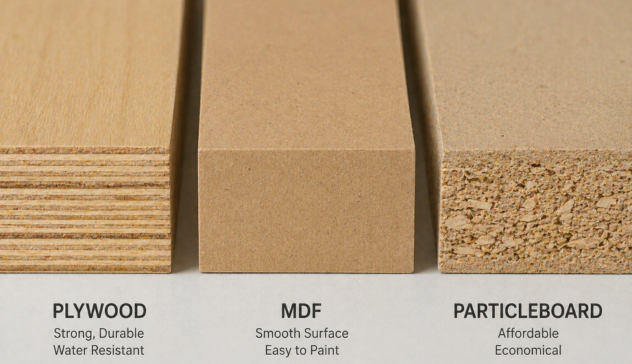
Plywood is made by gluing sheets of wood together with the grain alternating direction in each layer. That cross-grain construction is what gives it strength. It does not crumble. It holds screws. It bends without breaking.
For Indian kitchens, you've got three grades to know:
- MR (Moisture Resistant): Entry-level. Fine for bedrooms, wardrobes, dry areas. Don't use it in the kitchen. Just don't.
- BWR (Boiling Water Resistant): A step up. Handles humidity reasonably well. Decent for kitchens in dry-climate cities.
- BWP (Boiling Water Proof): The real deal. The glue line survives boiling water. This is what you want.
When people ask about the best plywood for kitchen in India, the honest answer is BWP grade, 18mm thickness for the carcass, ISI 710 marked. That's the spec sheet you actually want.
A step beyond that is marine plywood for kitchen units, which is built to survive constant water exposure — think yacht decks. It's more expensive than standard BWP, but if your kitchen sits in a coastal city or your sink area stays wet, the upgrade pays for itself.
Why Plywood Wins for Most People
- Holds hinges and screws for 15+ years without sagging
- Resists warping in humid climates (when you pick BWP grade)
- Can be laminated, veneered, painted, or finished any way you like
- Termite-resistant plywood options are widely available — most ISI-marked BWP brands now treat the wood at the factory level
- If a shutter chips, a carpenter can actually fix it.
The Trade-offs
- It costs more upfront. A solid plywood modular kitchen is roughly 30–50% more expensive than a particleboard one.
- Quality varies wildly. The market is full of fake ISI marks and under-thickness sheets. Buy from a brand, get a bill, and check the IS 710 stamp on every sheet.
- It's heavier. If you're on the 14th floor with a slow lift, your installation day will not be fun.
When comparing waterproof plywood for kitchen options against MDF or particleboard, plywood is the only one of the three that can actually be called water-resistant in any meaningful sense. The others can be moisture-treated, but they're not waterproof. Big difference.
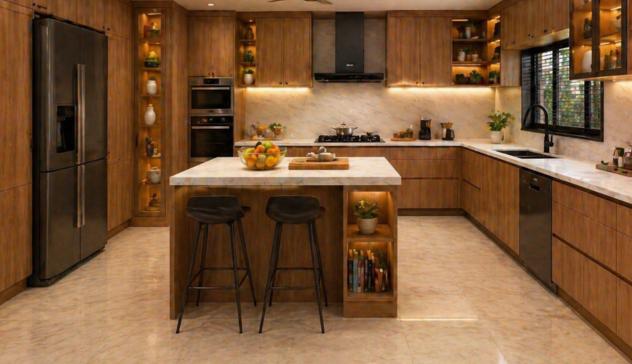
Option 2: MDF: Smooth Finish, Short Life
MDF stands for Medium Density Fibreboard. It's wood fibres pressed together with resin and heat into a dense, uniform board. The surface is flat and smooth — almost too smooth. That's what makes it perfect for painted finishes, lacquer work, and CNC routed designs (those grooves and patterns you see on premium-looking shutters).
If you've been pricing out high-gloss white kitchens or fluted shutter panels, the supplier was almost certainly quoting MDF. There's a reason — plywood doesn't take paint as cleanly because of its grain.
Where MDF Genuinely Shines
- Painted shutters and lacquered finishes look better on MDF than on ply
- Cheaper than plywood (15–25% less for the same kitchen)
- Smooth surface means no telegraphing of grain through paint
- CNC-cut designs come out crisp
Where MDF Falls Apart (Sometimes Literally)
Here's the honest part of any plywood vs MDF for kitchen discussion: MDF and water are enemies. One leak under the sink, one steam exposure that goes on too long, and the bottom edge of an MDF cabinet will swell, crumble, and never recover. You can't sand it back. You can't dry it out. The fibres have already broken.
The fix the industry came up with is HDHMR — High Density High Moisture Resistant board. It's basically MDF with denser packing and waterproof resin. When people ask about HDHMR vs plywood, here's the straight answer: HDHMR handles moisture far better than regular MDF, but it still doesn't match BWP plywood for screw retention or long-term joint stability. It's a middle ground. Better than MDF, not as good as ply.
So in any plywood vs MDF for kitchen comparison for Indian conditions, plywood wins on durability. MDF (or HDHMR) wins on finish. Decide what matters more to you.
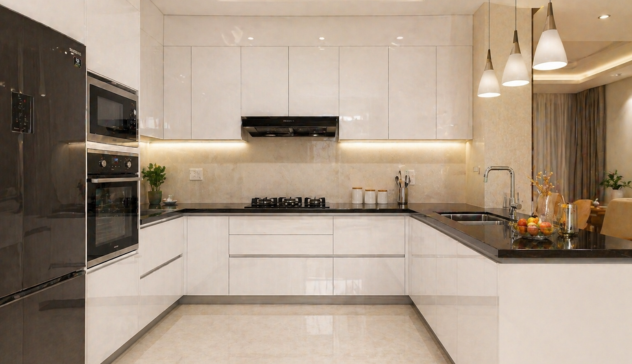
Option 3: Particleboard — The One to Skip
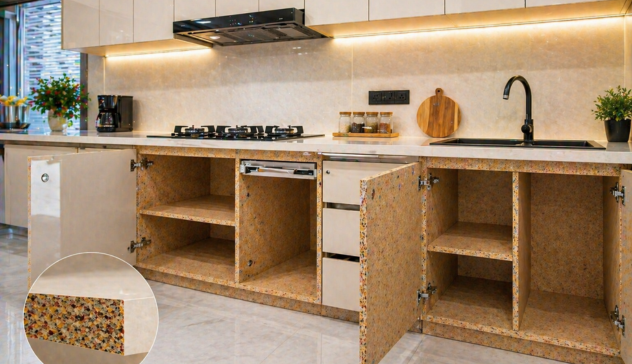
Let's just be honest about this. Particleboard is wood chips, sawdust, and resin pressed into a sheet. It's the cheapest panel material available. It's what most ready-to-assemble flat-pack furniture is made of. And it does not belong in a kitchen — at least not the carcass.
The particle board vs plywood debate isn't really a debate when you look at how the materials behave over time:
|
Issue |
Particleboard |
Plywood |
|
Holds screws after 5 years |
Often no |
Yes |
|
Survives a water spill |
No |
Yes (BWP grade) |
|
Termite resistance |
Poor |
Good (treated grades) |
|
Resale value |
Drops fast |
Holds up |
Particleboard sags under weight. The screws strip out. The edges chip. Once moisture gets in, the chips swell and the whole panel turns to mush.
Could you use it for very low-budget rental units, or for a kitchen you plan to replace in 3 years? Sure. For anything else — including any home you actually own — skip it. The savings in the particle board vs plywood comparison disappear the first time you have to replace a swollen base unit.
What About Cost? Real Numbers, Not Marketing Numbers
Let's talk kitchen cabinet price in India — for a standard 8x10 ft modular kitchen, factory-assembled, with basic accessories:
- Particleboard with laminate: ₹1,20,000 – ₹1,80,000
- MDF with laminate or paint: ₹1,80,000 – ₹2,80,000
- HDHMR with finish: ₹2,20,000 – ₹3,20,000
- BWP plywood with laminate: ₹2,50,000 – ₹3,80,000
- Marine plywood with premium finish: ₹3,50,000 – ₹5,50,000+
These ranges shift based on city, brand, hardware (Hettich/Hafele vs unbranded), countertop, and whether you're including appliances. But the relative gaps stay roughly the same.
Now do the lifespan math. A particleboard kitchen at ₹1,50,000 that lasts 6 years costs you ₹25,000 a year. A plywood kitchen at ₹3,00,000 that lasts 15+ years costs you ₹20,000 a year — and you don't deal with a renovation in year 7. The "cheaper" option usually isn't.
This is also why comparing only the upfront kitchen cabinet price in India is a trap. The real number is the cost per year of use. Run that math before you sign anything.
Match the Material to the Buyer — Which One Is You?
Different buyers, different right answers. Be honest about which you are.
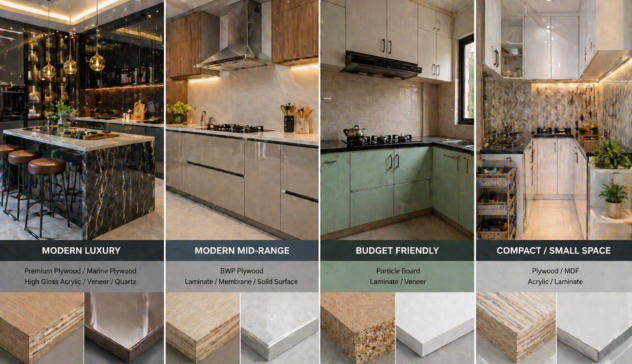
The Long-Term Homeowner — You bought your flat, you're staying. Go with BWP plywood for the carcass, every time. Marine plywood for the under-sink unit if your budget allows. This is the best plywood for the kitchen in India for your situation, and it'll outlast your next two cars.
The Renovator on a Budget — You want a real upgrade, but you've got a ceiling. Mix it: BWP plywood for the base units (they take all the moisture and weight), HDHMR for the wall units (they stay dry and you save 15-20%). Best of both worlds.
The Style-First Buyer — High-gloss white, fluted panels, lacquer finish. You care about how it looks more than how it ages. MDF or HDHMR shutters on a plywood carcass are the cleanest answer. You get the finish you want and the structure that lasts.
The Rental / Short-Stay Buyer — Flipping the place in 3 years, or it's a rental property where tenants will be tough on it. Particleboard is acceptable here — just keep it away from water and replace what fails. Don't sink premium money into a place you're leaving.
The Coastal / Heavy Humidity Buyer — Mumbai, Chennai, Kochi, Goa, Vizag, Kolkata. Salt air and damp eat MDF and particleboard alive. Don't compromise. Marine plywood for the kitchen carcass, BWP plywood for kitchen wall units, sealed edges everywhere.
A Few Things Most Buyers Get Wrong
A few quick, honest tips, because the showroom won't always tell you these:
- Ask for the actual brand and grade in writing. "Branded plywood" is not a spec. "Century Sainik 710 BWP, 18mm" is.
- Check thickness with a vernier caliper if you can. 18mm carcass should be 18mm. Some sellers ship 16mm and call it 18mm.
- The hardware matters as much as the material. Cheap hinges on great plywood will still fail. Soft-close hinges from a real brand are non-negotiable.
- Edge banding is where moisture sneaks in. Make sure all four edges are properly banded — including the back edges nobody usually checks.
- Ask about termite treatment. Real termite-resistant plywood has the treatment certificate. If the seller says "yes ji, sab treated hai" without showing paperwork, assume it isn't.
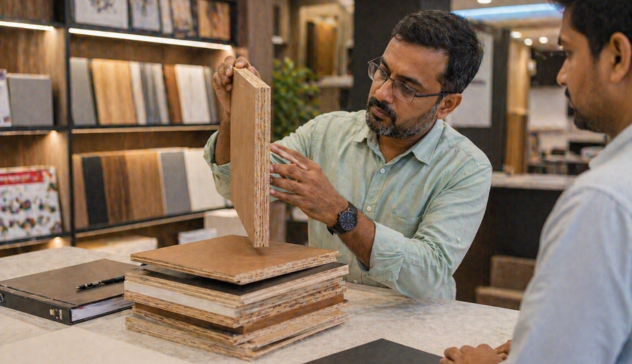
Build It Right the First Time with Express Kitchens
At Express Kitchens, we focus on what actually matters: durability, consistency, and long-term performance.
- All-Plywood cabinet construction as standard
- Soft-close hinges and full-extension drawers included
- Built using precision manufacturing for consistent quality
- Expert guidance so you choose the right materials from day one
When you visit us, you don’t just see a finish, you understand what’s inside the cabinet, how it’s built, and why it will last.
Conclusion
For a home you actually live in, in any Indian climate: BWP plywood for the carcass, your choice of finish on the shutters. Spend the extra now, save yourself the renovation later. That's the real takeaway from any honest plywood vs MDF for kitchen discussion.
If you're on a tighter budget, HDHMR is a reasonable compromise, better than MDF, cheaper than ply. If you're on the coast, go to the marine grade and don't look back. And if anyone tries to sell you particleboard for the base units of a permanent kitchen, walk out.
Your kitchen is the one room you'll touch every single day for the next 15 years. The right modular kitchen material isn't an upgrade; it's just doing it properly the first time.
FAQ
1. Which material is best for kitchen cabinets: plywood, MDF or particle board?
Plywood is the best choice for kitchen cabinets because it is strong, moisture-resistant, and holds screws well over time. MDF works better for painted shutters, while particle board is only suitable for very low-budget or temporary kitchens.
2. Is BWP plywood worth it for kitchen cabinets?
Yes, BWP (Boiling Water Proof) plywood is worth the investment. It handles moisture, humidity, and daily wear much better than other materials, making it ideal for long-lasting kitchen cabinets.
3. What is the difference between MDF and plywood in kitchen use?
Plywood is stronger and more durable, especially in wet areas like under the sink. MDF has a smoother surface and is better for painted finishes but can swell and get damaged when exposed to water.
4. How long do plywood kitchen cabinets last?
Good-quality plywood cabinets can last 15 to 20 years or more when combined with proper hardware and installation. They maintain structure and strength much longer than MDF or particle board cabinets.
5. Is particle board good for modular kitchens?
Particle board is not recommended for permanent kitchens because it is weak, absorbs moisture quickly, and loses strength over time. It may be used only in low-budget or short-term setups where durability is not a priority.